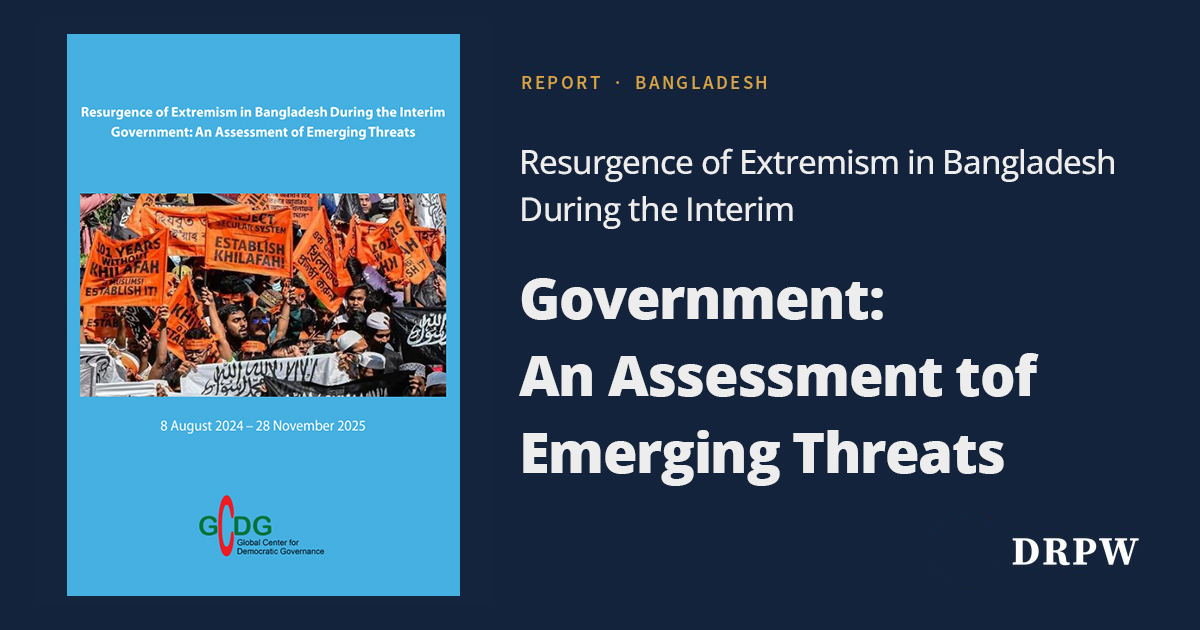
An updated report documents the alarming resurgence of Islamist extremism, institutional disruption, and security challenges in Bangladesh following the political transition of August 2024. Prepared and published by the Global Center for Democratic Governance (GCDG), the publication examines how banned organizations have re-entered public life, security structures have been restructured, and minority communities and civic freedoms have faced severe pressures under the interim administration.
Key figures and overview
As stated in the report:
- Attacks on Minorities and Shrines: Documentation highlights 185 Sufi graves or shrines damaged, 152 Hindu temples damaged, and thousands of communal hate crimes reported between August 2024 and mid-2025.
- Arrests and Detentions: Over 359,798 arbitrary arrests were recorded across a ten-month period following the August 2024 transition.
- Casualties of Unrest: Reports note significant casualties and mob violence incidents, alongside severe impacts on cultural icons, educational institutions, and freedom of expression.
What the report covers
The report outlines various dimensions of the crisis through detailed thematic sections:
- Political Transition and Institutional Instability: Examines post-transition restructuring within security and counterterrorism frameworks, creating operational vacuums exploited by radical groups.
- Public Resurgence of Banned Islamist Groups: Details the return of groups like Hizb-ut-Tahrir Bangladesh (HTB), their public rallies such as the “March for Khilafat,” and campus-based recruitment efforts.
- Broader Islamist Mobilization: Analyzes the grassroots influence of Hefazat-e-Islam, the political rehabilitation of Jamaat-e-Islami, and emerging transnational extremist ties.
- Social Impact and Civic Freedoms: Highlights escalating pressures on religious and ethnic minorities, the curtailment of free expression, and the rise of gender-based moral policing.
- Regional Security and Geopolitical Realignment: Assesses border vulnerabilities, cross-border infiltration risks, diplomatic strain with neighboring countries, and shifting foreign alliances.
Calls for action
The report emphasizes the urgent need to restore counterterrorism capacities, reassert secular governance, protect vulnerable communities, and rebuild regional security partnerships to prevent further destabilization.
Read the Full Report
Read the complete report below, open it in a new tab, or download the PDF for offline reading.
Report details
- Title: Resurgence of Extremism in Bangladesh During the Interim Government: An Assessment of Emerging Threats
- Prepared and published by: Global Center for Democratic Governance (GCDG)
- Reporting period: 8 August 2024 – 28 November 2025
The findings, allegations and opinions in this report are those of its publisher.
About the Author