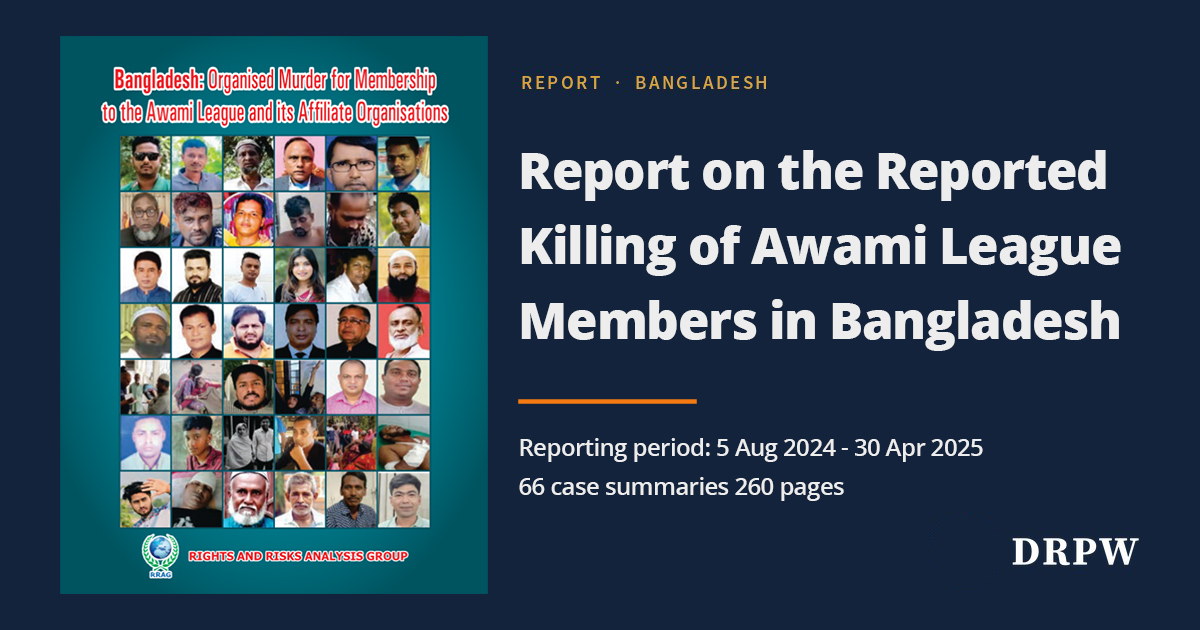
This report documents the reported killing of members of the Awami League and its affiliate organisations in Bangladesh between 5 August 2024, after the fall of the Sheikh Hasina government, and 30 April 2025. It presents case summaries based on Bangladeshi media reports, lists of the victims, and an argument that the killings may amount to crimes against humanity.
Key figures
As stated in the report:
- 123 members of the Awami League and its affiliate organisations murdered or killed in custody
- 102 killed for being members of the Awami League and its affiliate organisations
- 21 other Awami League cadres killed in custody during the same period
- 41 Awami League leaders hacked to death, sometimes by slitting of throats, which the report describes as “Taliban style”
- 66 case summaries, each with the original news report attached as an annex
The affiliate organisations named in the report include the Swechasebak League, Chhatra League, Juba League, Matsojibi League and Krishak League. The report states that these figures are only “the tip of the iceberg”, because not all killings were reported in the media and it was not possible to monitor all targeted killings.
Methodology
The report is principally based on cases of murder reported in Bangladeshi media in Bengali. Because both the Awami League and its Chhatra League were banned by the Interim Government, it was not possible to interview victims’ relatives. A brief English translation of the Bengali news report on each case is provided.
Emblematic cases
The report presents case summaries from August 2024 onwards. It states that even mentally unstable and maimed persons, women and children were not spared, and highlights four cases:
- A mentally unstable man killed by a student mob on the Dhaka University campus on 19 September 2024
- A former Rajshahi University Chhatra League leader, previously maimed in an attack in 2014, beaten to death on 8 September 2024
- The mother of a Chhatra League leader, hacked while offering prayers on 5 December 2024
- Two persons, including a 12-year-old class-five student, killed on 17 December 2024 by alleged supporters of Dr Muhammad Yunus, which the report says was over a “Joy Bangla” Facebook post made months earlier
Impunity and accountability
The report argues that political rhetoric and the banning of the Chhatra League on 24 October 2024 and of the Awami League on 11 May 2025 effectively encouraged vengeance and justified acts of vendetta with impunity. It contends that the Interim Government prevented the truth from emerging, and gives two reasons:
- It restricted the mandate of the UN human rights office (OHCHR) fact-finding inquiry to 1 July to 15 August 2024. The investigation took place from 16 September to October 2024, when Awami League members were facing violence and could not depose before the team because of fear.
- It barred law enforcement personnel from arresting or filing cases against anyone involved in the July–August uprising, including for the murder of 44 policemen, which the report describes as absolute impunity.
The report also states that in most of the cases it covers, victims’ relatives were too scared to file police complaints, as admitted by the police and other authorities.
Violence before 5 August 2024
Citing the OHCHR fact-finding report, the report notes that as many as 1,400 people may have been killed between 15 July and 5 August 2024, mostly by security forces. It adds that, according to the same OHCHR report, 144 officials and members of the Awami League and its affiliated organisations were killed between 1 July and 15 August 2024, and that police reported 44 officers killed and 2,308 injured in that period. On this basis, the report argues that both State forces and non-State actors committed such offences, and that the targeted killings of Awami League members continued up to the date of the report.
The legal argument
The report argues that the killings of Awami League members may constitute acts committed as part of a widespread or systematic attack against a civilian population, including murder and torture, and persecution of an identifiable group on political grounds. In its view, these acts meet the criteria for crimes against humanity under Article 7 of the Rome Statute of the International Criminal Court.
It contends that former Prime Minister Sheikh Hasina remains liable for offences committed leading up to her fall, and that Chief Adviser Dr Muhammad Yunus and Adviser for Home Affairs Jahangir Alam Chowdhury are liable for the murders of Awami League members under the Interim Government through command responsibility under Article 28. It compares the situation to the ICC’s examination of post-election violence in Kenya in 2007/2008, and cites the ICC’s Duterte case as relevant to the custodial deaths of Awami League leaders.
Noting that Bangladesh has ratified the Rome Statute, the report calls on the ICC Prosecutor to initiate an investigation on her own initiative under Article 15 into crimes against humanity from 1 July 2024 through the tenure of the Interim Government, based on the OHCHR report and this report.
What the report contains
- Methodology
- Executive summary: the charge of crimes against humanity
- Emblematic cases of murder for membership of the Awami League (66 cases)
- List of Awami League members murdered under the Interim Government
- List of Awami League members hacked to death under the Interim Government
- Original news reports on the list of Awami League members murdered under the Interim Government
- List of Awami League leaders killed in custody
Read the Full Report
Content note: the report includes descriptions of killings and photographs of victims.
Read the complete 260-page report below, open it in a new tab, or download the PDF for offline reading.
Report details
- Title: Bangladesh: Organised murder for membership to the Awami League and its affiliate organisations
- Prepared and published by: Rights and Risks Analysis Group (RRAG), New Delhi
- First published: June 2025
- Reporting period: 5 August 2024 – 30 April 2025
The findings, allegations and opinions in this report are those of its publisher.
About the Author