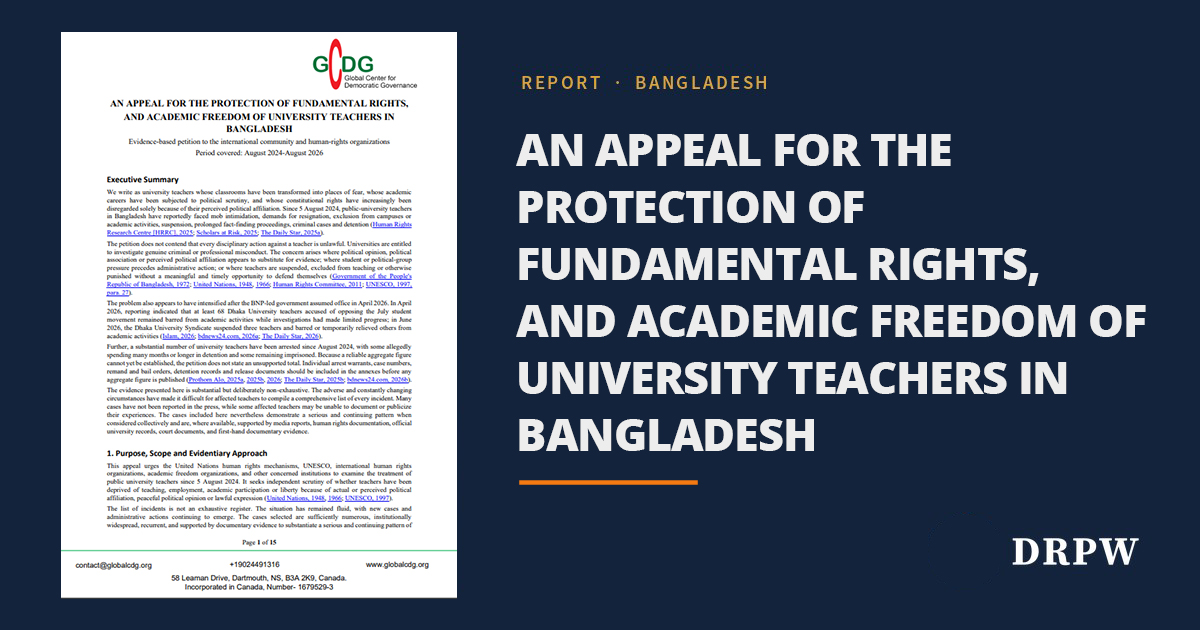
An updated report documents the severe challenges facing academics, including mob intimidation, forced resignations, suspensions, prolonged fact-finding proceedings, criminal cases, and detention of public-university teachers in Bangladesh between August 2024 and August 2026. Published by the Global Center for Democratic Governance (GCDG), the publication examines how political opinion and perceived political affiliation have increasingly been used to target educators, undermining academic freedom and due process.
Key figures and overview
As stated in the report:
- 150+ Teachers Forced to Resign: At least 150 teachers across Bangladesh were reportedly forced to resign in the initial weeks following the August 2024 political transition.
- Thousands of Educators Impacted: Broader education sector estimates indicate nearly 3,500 teachers across approximately 2,000 institutions faced harassment, with around 1,000 teachers deprived of salaries or unable to return to classrooms.
- Institutional Probes: Universities initiated investigations into 404 teachers across 22 public universities—including 58 from the University of Dhaka—based on allegations concerning pro-Awami League activities and communications.
- Arrests and Detentions: Several university professors and faculty members, such as Dhaka University Law Professor Sheikh Hafizur Rahman and Sociology Professor A. K. M. Jamal Uddin, faced arrest and detention under anti-terrorism laws.
What the report covers
The report outlines various dimensions of the crisis through detailed thematic sections:
- Mob Intimidation, Humiliation and Forced Resignation: Details the intense pressure from student and political groups demanding the resignation or removal of teachers perceived as associated with the previous establishment.
- Suspension and Exclusion from Academic Activities: Examines the prolonged barring of teachers from classrooms and academic functions across institutions like Dhaka University, Jahangirnagar University, and others without timely disciplinary conclusions.
- Fact-Finding Committees and Procedural Harassment: Highlights concerns where institutional inquiry committees were used to subject teachers to intimidating questioning, short notice periods, and continuous exclusion.
- Political Opinion and Affiliation: Explores how competing teacher organizations and university syndicates advanced measures, memoranda, and probe committees targeting individuals based on political alignment during and after the July 2024 uprising.
- Arrest and Prolonged Detention: Documents specific cases of educators handed over to police by activists and jailed under amended anti-terrorism laws.
- Interference with Religious Observance and Communal Participation: Analyzes restrictions on memorial programs, funeral locations, and traditional campus events such as iftar mehfils, raising concerns over equal treatment and freedom of association.
- Adverse Measures Across Public Universities: Summarizes disciplinary actions—ranging from suspensions and compulsory retirements to demotions and salary reductions—at institutions including Jahangirnagar University, RUET, Islamic University, and Begum Rokeya University.
Calls for action and international standards
The report underscores that these actions violate provisions of the Constitution of Bangladesh (such as Articles 27, 31, and 39) as well as international human rights instruments, including the ICCPR, ICESCR, ILO Convention No. 111, and UNESCO recommendations on higher-education teaching personnel. It urges international bodies, UN human rights mechanisms, and academic freedom organizations to review cases of arbitrary detention, ensure due process, and protect educators from political retaliation.
Read the Full Report
Read the complete 15-page report below, open it in a new tab, or download the PDF for offline reading.
Report details
- Title: An Appeal for the Protection of Fundamental Rights, and Academic Freedom of University Teachers in Bangladesh
- Prepared and published by: Global Center for Democratic Governance (GCDG)
- Reporting period: August 2024 – August 2026
The findings, allegations and opinions in this report are those of its publisher.
About the Author