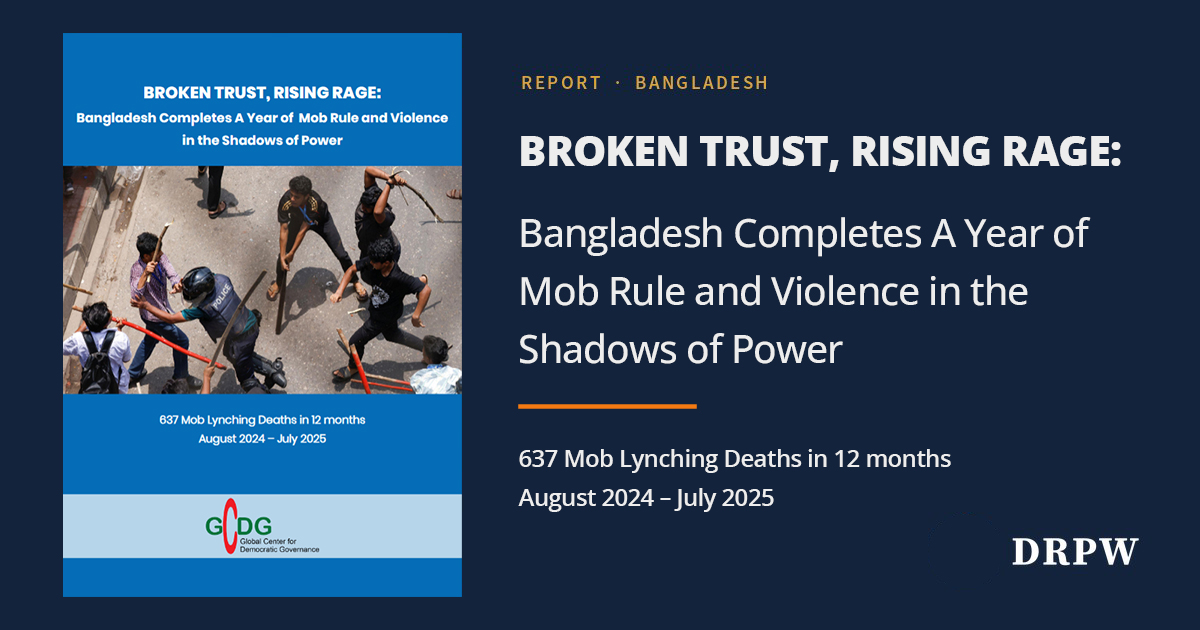
Broken Trust, Rising Rage: Bangladesh Completes a Year of Mob Rule and Violence in the Shadows of Power is a report documenting 637 mob lynching deaths in 12 months, from August 2024 to July 2025. It was published on 2 August 2025 by the Global Center for Democratic Governance (GCDG).
The Core Finding
The report states that the political transition following the August 2024 uprising, which forced Prime Minister Sheikh Hasina from office after 15 years in power, has seen a disturbing escalation in mob violence in Bangladesh.
From August 2024 through July 2025, at least 637 people, including 41 police officers, were lynched in acts of vigilante justice. The report describes this as one of the deadliest waves of extrajudicial killings in the country’s recent history.
By contrast, 51 lynching deaths were recorded in all of 2023, under the previous administration. The report states that mob lynching deaths increased more than 12 times compared to 2023.
Month-wise Deaths
| Month | Deaths |
|---|---|
| August 2024 | 386 |
| September 2024 | 30 |
| October 2024 | 32 |
| November 2024 | 20 |
| December 2024 | 25 |
| January 2025 | 21 |
| February 2025 | 14 |
| March 2025 | 32 |
| April 2025 | 27 |
| May 2025 | 25 |
| June 2025 | 10 |
| July 2025 | 15 |
| Total | 637 |
Mass-Casualty Incidents
- At The Zabeer Jashore Hotel in Jashore, 24 people were burnt to death on 4 August 2024.
- Among the 637 deaths, 182 people were burnt at Gazi Tyres in Rupganj, Narayanganj on 25 August 2024. The report states that their names and details were not published.
An Incomplete Count
The report notes that, because of strong media censorship, it could not collect full information on all mob lynching deaths. It says the list should be considered incomplete.
Why It Happened, According to the Report
- Power vacuum and loss of confidence. The fall of a longstanding regime created both a power vacuum and a public crisis of confidence in the justice system, which many now perceive as either absent or co-opted by political agendas.
- Overstretched institutions. With police forces overstretched, court systems paralyzed, and local leaders either targeted or in hiding, citizens increasingly took justice into their own hands.
- Flashpoints in public spaces. Public spaces once protected by law have become flashpoints for mob killings, often triggered by nothing more than suspicion, rumor, or political resentment.
Political and Communal Undertones
While many incidents stemmed from accusations of theft or harassment, the report says a large portion of the violence had political or communal undertones.
- Local human rights organizations have reported that over 70% of lynching victims since August 2024 had ties to the former ruling Bangladesh Awami League or its affiliated student and labor wings.
- Other victims have included religious minorities, particularly Hindus and Ahmadiyya Muslims, accused of blasphemy or conspiracy through viral social media posts, often with little or no evidence.
- One of the most horrific incidents cited was the public lynching of Lal Chand Sohag, a Hindu social worker, outside Mitford Hospital on 9 July 2025. His death was livestreamed across platforms, igniting both national outrage and fear.
The Role of Social Media
The report describes social media as a double-edged sword. Citizens use it to expose injustice, but it is also used to amplify panic and hatred. Misinformation and inflammatory content have played key roles in mobilizing mobs within minutes.
In one incident in Chattogram, a Facebook post falsely claimed that a local Hindu man had desecrated the Quran. It led to a mob attack that left two dead and several homes burned. Although the post was proven false hours later, the report says the damage was irreversible.
Government Response
The interim government, led by Nobel Laureate Muhammad Yunus, has vowed to crack down on vigilante violence. According to the report, authorities have promised a “zero tolerance” approach and launched nationwide campaigns promoting legal awareness and community policing.
However, the report states that prosecution remains rare, with only a handful of arrests for mob killings and fewer still leading to convictions. Critics argue that the government has prioritized political consolidation over the rule of law, focusing more on purging remnants of the former regime than on restoring judicial order. Meanwhile, public trust in institutions continues to plummet, fueling the very violence the state seeks to prevent.
Fear in Daily Life
Beyond the numbers, the report says the rise in mob violence has left deep psychological scars on communities across Bangladesh. Fear has become a daily companion in many neighborhoods. Parents are hesitant to let children walk alone, and shopkeepers speak in hushed tones when discussing political topics.
A recent survey by the South Asian Network on Economic Modeling (SANEM) found that:
- 71% of Bangladeshi youth believe mob violence is now a regular part of public life
- 47% fear becoming a target of politically motivated attacks
What the Report Says Is Needed
The report warns that, unless urgent and systemic reforms are made, mob justice may become a permanent feature of Bangladesh’s political landscape. The reforms it lists range from:
- police restructuring
- judicial independence
- digital misinformation controls
- civic education
“The last year has shown that when institutions fail, mobs rise.” The question facing Bangladesh now is whether it can reclaim the rule of law, or whether the crowd, not the court, will continue to decide who lives and who dies.
The Victim List
The report includes a detailed list of mob lynching deaths. For each entry it provides the date, name and address, a photo where available, a news link and a QR code. The list covers deaths from 2 August 2024 to 30 July 2025.
Read the Full Report
The full report contains the complete month-wise chart, the narrative preface and the full list of victims.
Report Details
- Title: Broken Trust, Rising Rage: Bangladesh Completes a Year of Mob Rule and Violence in the Shadows of Power
- Publisher / Creator: Global Center for Democratic Governance (GCDG)
- Published: 2 August 2025
- Period covered: August 2024 – July 2025
- Total deaths documented: 637, including 41 police officers
The figures and claims in this post are those of the report, summarised here for readers.
About the Author