drpw-Bangladesh_Yunus-and-Assault-on-History-Web
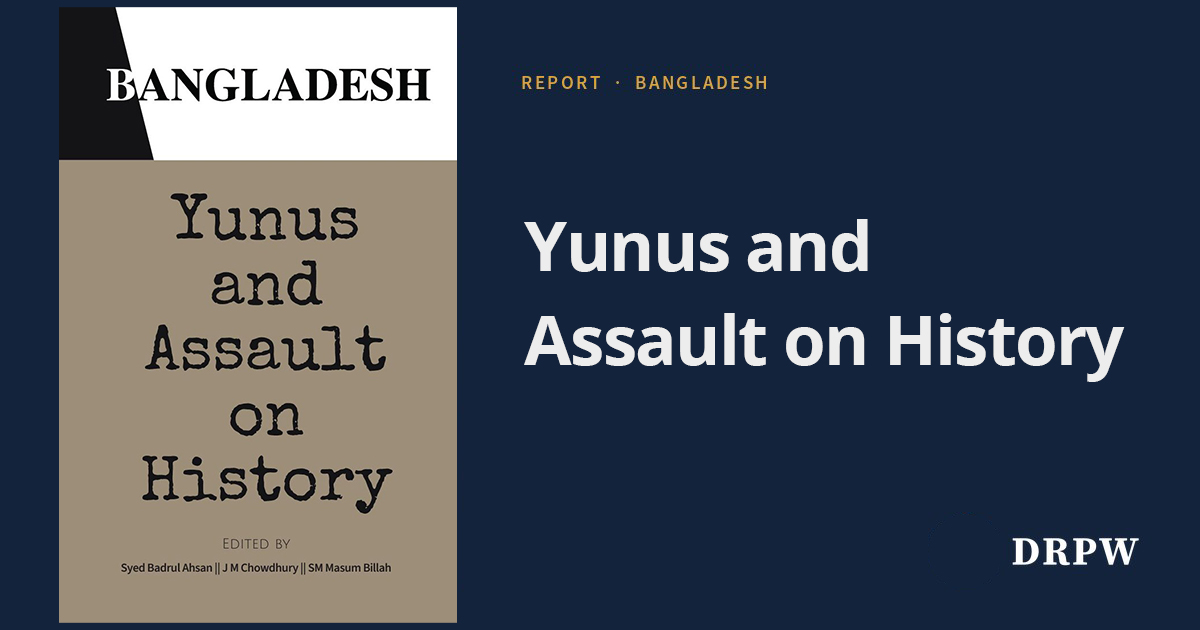
Bangladesh: Yunus and Assault on History is a compilation of analyses and assessments by scholars on the threats Bangladesh has faced since the fall of its elected government in August 2024. Edited by Syed Badrul Ahsan, J M Chowdhury and SM Masum Billah, the book was first published in December 2025 and was produced by the Global Center for Democratic Governance (GCDG).
The book argues that the interim government headed by Muhammad Yunus is unconstitutional. It describes the situation since August 2024 as an existential crisis for the republic founded in 1971. It is dedicated to “the victims of historical distortion, and to future generations to whom history must remain faithful.”
Book at a Glance
- 312 pages, 9 chapters plus notes on contributors
- First published: December 2025
- Editors: Syed Badrul Ahsan, J M Chowdhury, SM Masum Billah
- Contributors: Syed Badrul Ahsan, Dr. J M Chowdhury, Dr. S M Masum Billah, Dr. Mohammad Shahidullah, Dr. Shahriar Rafiq, Barrister Tapas Kanti Baul, M. Islam, Zayadul Ahsan and Ahmed Saeed
What the Book Covers
- The Judicial Theatre of Hasina Verdict: A Critical Legal Analysis. The chapter calls the verdict a blend of political vendetta and judicial misdirection. It argues that an interim administration of contested legality arranged a trial in absentia built on fragile evidence and doctrinal distortion. It also criticises the Tribunal’s use of Joint Criminal Enterprise and command responsibility.
- Governance in Retreat: Institutions Under Siege. It looks at the 2024 uprising and the expectations it raised. It argues that institutional autonomy has eroded, oversight mechanisms are paralysed and space for dissent has contracted.
- The Illusion of Stewardship: Human Rights Regression under the Yunus-Led Interim Government. It examines constitutionality and ethics, including individuals holding dual citizenship and the authority said to be handed to them to tamper with the constitution.
- Extremism and Security Failures. It examines how religious extremism, together with a collapse of security, has allegedly undermined the State and secular governance.
- Collapse of the Rule of Law and Public Security. It examines the trial of former Prime Minister Sheikh Hasina and what it describes as a witch hunt of those associated with the Awami League government, along with mob violence.
- Reemergence of Impunity in Bangladesh: Victims Ignored and Defence Denied. It discusses the immunity announced for those involved in the agitation between mid-July and early August 2024 through a Home Ministry press release.
- Economic Decline and Social Discontent. It covers the economic slide since August 2024, including banking, rising inflation, higher costs of living, increased government borrowing, the lowest ADP in recent years, and damage to the business environment from mob violence.
- The Mirage of Reform and Global Isolation. It argues that the reforms are hollow. It also argues that the July Charter has become a statement mired in confusion and is an assault on the constitutional order established in the era of liberation.
- Lessons, Reversals and the Road to Democratic Resilience. It argues that the installation of an unconstitutional regime has created a multi-dimensional crisis for the constitutional, economic and institutional foundations of the State.
Key Concerns Raised
- Legitimacy: The book argues that no provision of the constitution, including Article 106, supports the regime. It also says the constitution contains no caretaker system of government.
- Judiciary: It alleges that mob pressure forced members of the higher judiciary to resign, and that mobs have broken into courts.
- Dissolution of Parliament: It calls the dissolution of the Jatiya Sangsad on 6 August 2024 an act that deprived the regime’s commissions and reports of validity.
- Constitutional reform: It criticises the formation of a commission to restructure the 1972 constitution.
- Arrests and detention: It says journalists, ministers, lawmakers, advisers, judges and lawyers have been jailed, including a former chief justice and a former chief election commissioner.
- Bans and symbols: It points to the ban on the Awami League, Chhatra League and Jubo League, the ban on the slogan Joi Bangla, and the removal of images of Bangabandhu from institutions and currency notes.
- Vandalism: It reports attacks on murals and statues honouring Bangabandhu and others.
- Minorities and women: It says Hindu homes and families have come under repeated assault, and that women, Bauls and Sufi shrines have been targeted.
- Violence against police: It claims hundreds of policemen were lynched by mobs after August 2024 with no inquiry.
- Foreign policy: It describes strained relations with India and a growing closeness to Pakistan.
Calls to Action
The concluding chapter calls for a broad coalition of responsibility:
- Citizens and civic groups: Reject mob pressure, safeguard minorities, participate in elections and insist on peaceful mobilisation.
- Political parties: Restore internal democracy, reject violent street politics, and condemn political prosecution and press the government to lift the ban on the Awami League.
- State institutions: Restore professional independence, protect judges, civil servants and police from intimidation, and rebuild intelligence coordination to counter extremism.
- Civil society, media and academia: Practise rigorous fact-checking, resist ideological capture and promote inclusive narratives reflecting Bangladesh’s founding principles.
- Professional communities: Adopt ethical guidelines, maintain neutrality in political transitions and avoid endorsing extra-constitutional arrangements.
- International community: Condemn the politically motivated trials and call for them to be halted, call for the ban on the Awami League to be withdrawn, and support free, fair and inclusive elections.
Read the Full Report
The full book contains the detailed legal analysis, chapter-by-chapter arguments and references.
Report Details
- Title: Bangladesh: Yunus and Assault on History
- Publisher / Creator: Global Center for Democratic Governance (GCDG)
- Editors: Syed Badrul Ahsan, J M Chowdhury, SM Masum Billah
- First published: December 2025
The views and claims in this post are those of the book’s editors and contributors, summarised here for readers.
About the Author