The education sector in Bangladesh entered a period of profound disruption following the political crisis of July and August 2024. What began as student protests concerning the public-service quota system developed into a much broader nationwide movement, culminating in the resignation of the government on 5 August 2024 and the swearing-in of the Interim Government on 8 August 2024.
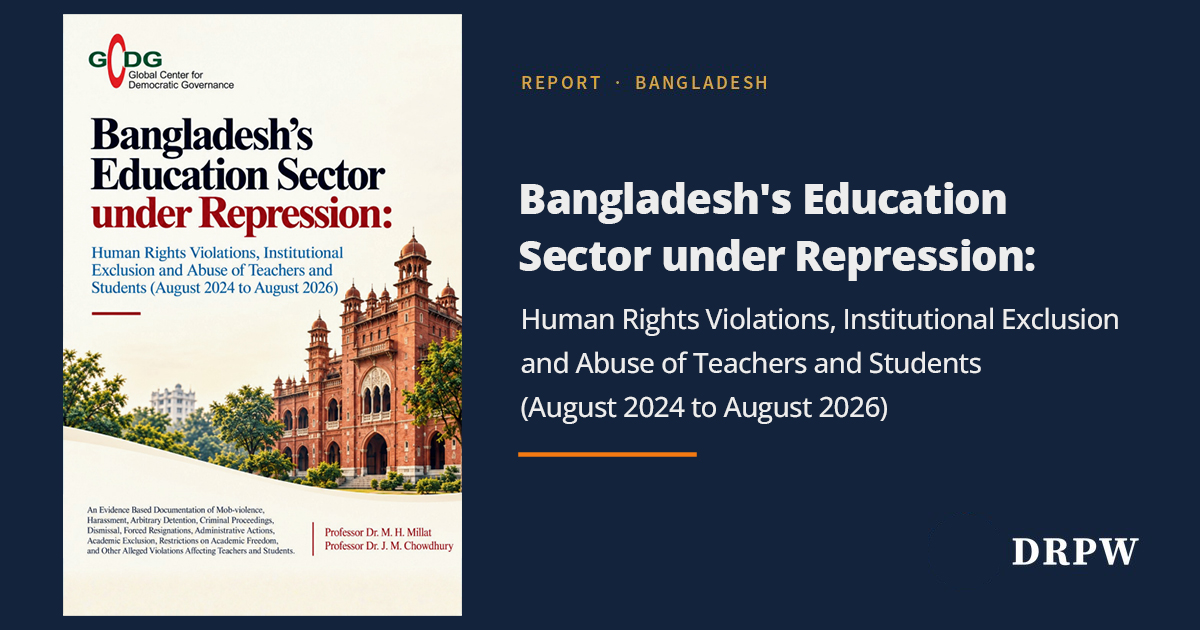
This comprehensive empirical documentation—compiled and published by the Global Center for Democratic Governance (GCDG)—examines academic repression and related human rights concerns affecting teachers, students, and education-related professional trainees across Bangladesh between August 2024 and August 2026. Covering primary and secondary schools, general colleges, public and private universities, engineering, medical, agricultural, technical institutions, and madrasas, the study investigates whether teachers and students have been able to participate in academic life without violence, coercion, arbitrary exclusion, or discriminatory punishment.
1. Nature of Academic Repression and Methodological Approach
A central analytical challenge highlighted in the documentation is distinguishing legitimate accountability from academic repression. Educational institutions have both the authority and responsibility to investigate credible allegations of violence, ragging, corruption, sexual abuse, and other misconduct. Academic freedom or political association does not exempt anyone from responsibility for proven wrongdoing. Equally, political identity, perceived affiliation, or participation in peaceful protest cannot substitute for evidence of individual misconduct.
The legal and human rights assessment is anchored in Bangladesh’s constitutional guarantees (Articles 27, 28, 31, 32, 35, 37, 38, and 39) alongside international instruments such as the ICCPR (1966), ICESCR (1966), the Convention on the Rights of the Child, and relevant ILO and UNESCO standards.
2. Statistical Scale and Sectoral Overview
The evidence base reveals substantial institutional actions and reported hardships across multiple tiers of education:
- Student Response Dataset: Out of 1,088 non-empty response records analyzed, informal academic exclusion constituted the largest category at 35.0% (381 records), followed by suspension (19.9%), show-cause notices (12.0%), expulsion (11.4%), forced institutional changes (8.6%), certificate cancellations (6.8%), and residential hall restrictions (6.2%).
- School and College Teacher Register: Comprising 188 raw entries, 59.6% reported forced resignations, 9.0% reported forced removals, and 31.4% recorded being unable to enter institutions despite no formal resignation or removal.
- Public Universities: Disciplinary series demonstrated large-scale administrative reviews. For instance, Dhaka University issued 403 show-cause notices (including 128 previously suspended students), while Jahangirnagar University reviewed 229 persons, resulting in 189 adverse outcomes and 40 clearances.
- Specialized Education: Engineering institutions recorded 142 finalized disciplinary measures across major universities like BUET, KUET, RUET, and CUET. Meanwhile, a nationwide medical investigation identified 222 total professionals and students (later expanding to 377 students) facing punitive actions across public medical colleges between August and October 2024.
3. Sector-Specific Findings
- Schools and Colleges: Primary and secondary teachers faced severe pressures, including compelled resignations, workplace coercion, and administrative show-cause notices following public criticisms or professional mobilizations (such as the 8 November 2025 primary teachers’ sit-in and the October 2025 MPO-listed teachers’ protests).
- General Universities: Public universities witnessed severe campus conflicts, including student-led mob violence, public humiliation, forced resignations of administrative heads (such as deans and vice-chancellors), and prolonged exclusion of teachers from academic duties. Legal harassment, arrest, and detention of academics were also documented.
- Specialized Institutions: Engineering, medical, and agricultural universities experienced governance restructuring, leadership turnovers, and substantial student disciplinary actions ranging from permanent expulsions to certificate cancellations (such as disciplinary proceedings involving 133 individuals at Bangladesh Agricultural University).
- Madrasas and Technical Institutions: Technical and vocational institutions faced administrative pressures and clashes during student mobilization. In the madrasa sector, independent teachers encountered restrictions during professional demands, while students—as detailed in qualitative interviews with 15 children—faced serious vulnerabilities regarding physical punishment, intimidation, and severe failures of child safeguarding and protection against sexual abuse.
Read the Full Report
Read the complete report below, open it in a new tab, or download the PDF for offline reading.
4. Cross-Sector Findings, Recommendations, and Reform
The study concludes that human rights violations stem from both improper institutional actions (coerced resignations, disproportionate punishments, and lack of due process) and institutional failures to act (failing to protect teachers from mob violence or failing to provide safe complaint mechanisms for abused children).
Key recommendations put forward by the authors include:
- Protecting teachers from coercion while preserving lawful accountability.
- Reviewing student disciplinary and exclusion measures individually with proper due process.
- Safeguarding peaceful professional and student mobilization.
- Separating criminal proceedings from internal academic misconduct.
- Strengthening child safeguarding and independent, confidential complaint mechanisms in educational institutions and madrasas.
- Ensuring effective remedies, educational continuity, and transparent evidence preservation.
The evidence underscores the urgent need for broad, independent, and systematic investigations to address unresolved grievances, establish accountability, restore justice, and strengthen the rule of law across Bangladesh’s entire education sector.
The findings, allegations and opinions in this report are those of its publisher.
About the Author